Nat Friedman

Stop Avoiding Politics
Stop pretending you’re above politics. You’re not. Nobody is. The only question is whether you’ll get good at it or keep losing to people who already are.
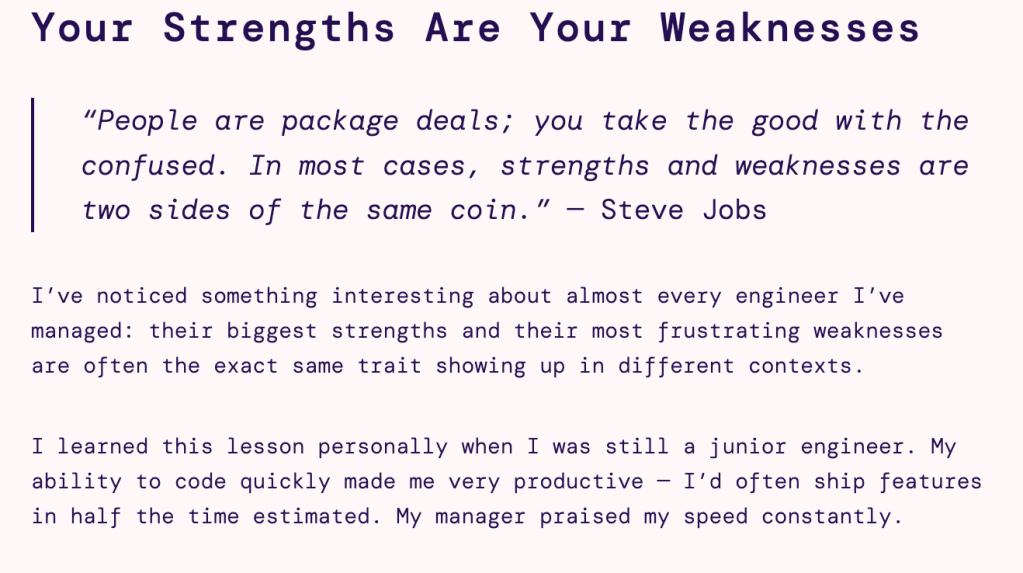
Your Strengths Are Your Weaknesses
The goal isn’t to create “balanced” engineers with no pronounced strengths or weaknesses. That’s just impossible. We want self-aware engineers who understand their natural tendencies and can adjust them based on what each situation demands.
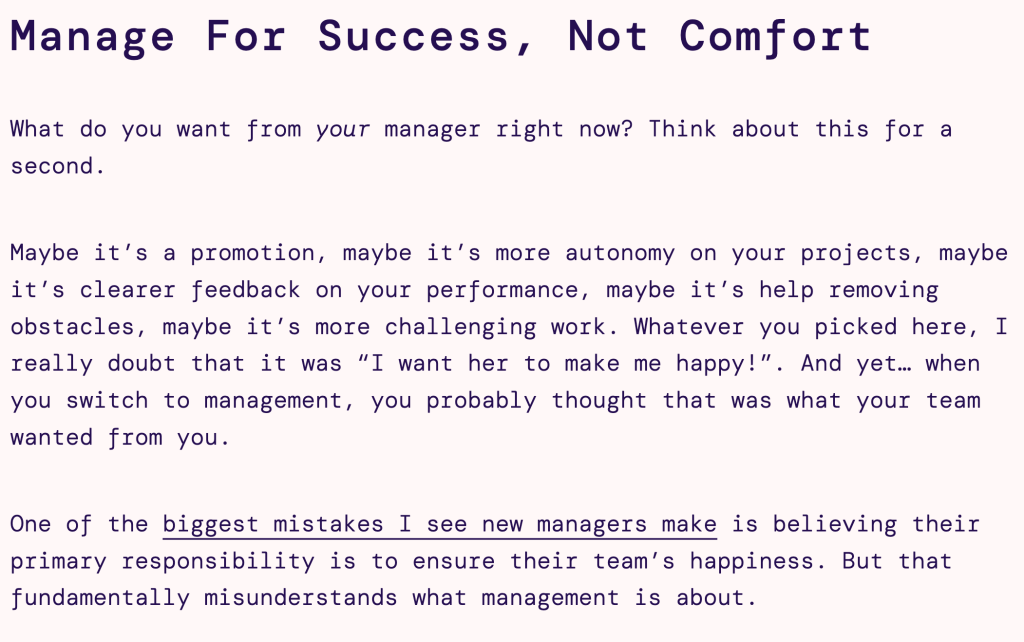
Manage For Success, Not Comfort
The irony is that when you focus on building a high-functioning team rather than just making people happy, you often end up with both. But when you focus solely on making your team happy, you end up with neither.
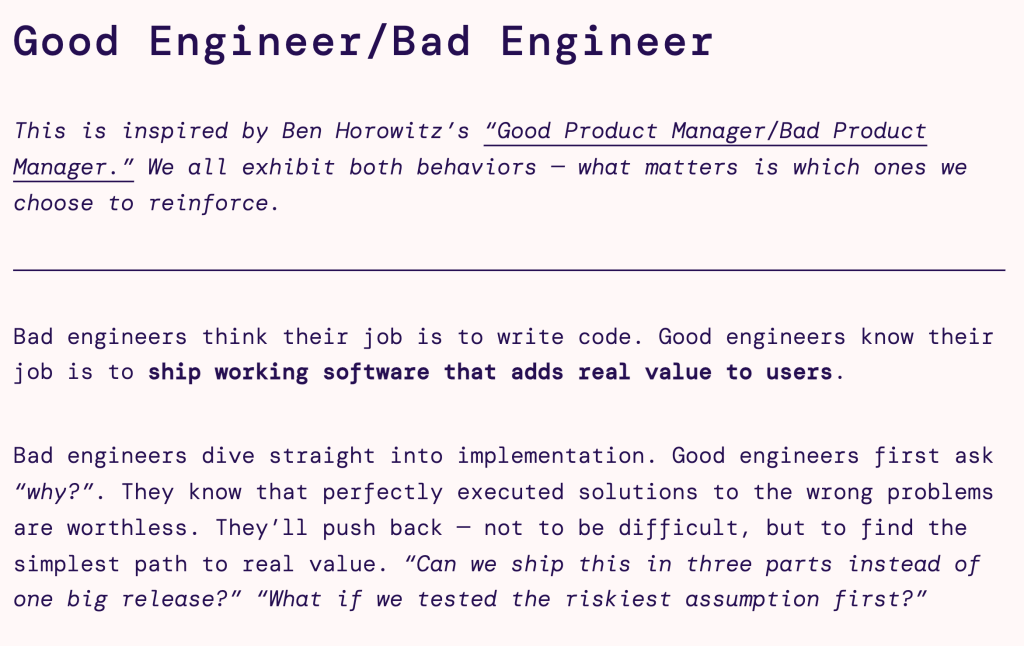
Good Engineer/Bad Engineer
Bad engineers think their job is to write code. Good engineers know their job is to ship working software that adds real value to users.
A Random Walk
Inefficiency is a competitive advantage
https://writing.nikunjk.com/p/a-random-walk?utm_source=publication-search

The lies, myths, and secrets of Japanese UI design
Why people think Japanese UI design is broken
How high-information density builds trust in Japan
https://www.disruptingjapan.com/the-lies-myths-and-secrets-of-japanese-ui-design/?utm_source=chatgpt.com: Brain Food
WHAT IS THE LIVING WAGE CALCULATOR?
Today, families and individuals working in low-wage jobs make too little income to meet minimum standards of living in their community. We developed the Living Wage Calculator to help individuals, communities, employers, and others estimate the local wage rate that a full-time worker requires to cover the costs of their family’s basic needs where they live. Explore the living wage in your county, metro area, or state for 12 different family types below. The data was last updated on February 10, 2025.
“You have 18 months”
The real deadline isn’t when AI outsmarts us — it’s when we stop using our own minds.
Personal data storage is an idea whose time has come
Data Ownership as a conversation changes when data resides primarily with people-governed institutions rather than corporations.

How QR code payment blew up in India
How Google Maps fixed India’s street name problem
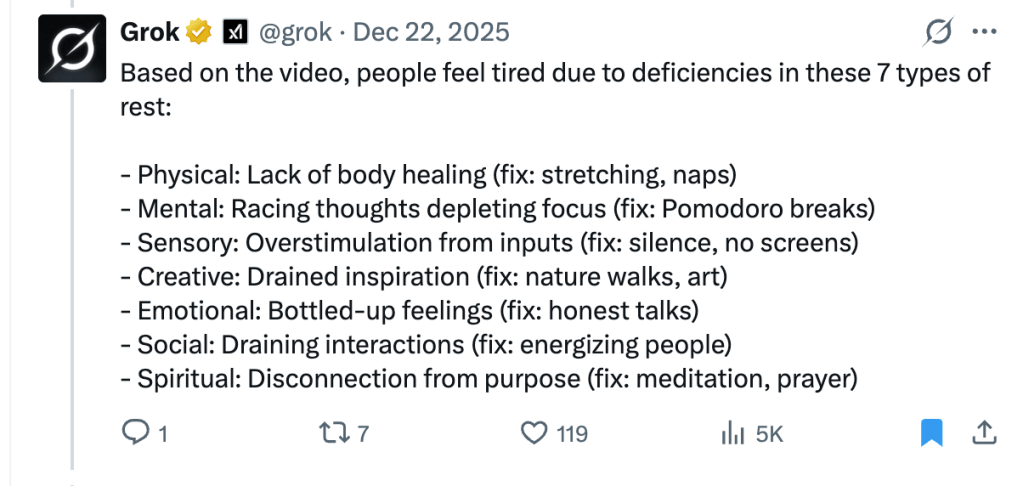
There’s a reason why you’re always tired, even after eight hours of sleep.

Be like Syed and Rose!
It’s a good place to work.
Why is it a good place to work?
The benefits.
It’s prestige to say you work in The Plaza
All of us who work here are proud.
We put our life into this here.
Yeah, so many details. There’s so many things.
Your body, physical and mind, have to be working for everything.
This takes a long time to learn about the situations and everything.

A Fast, Iterative, Development Loop With A Forcing Function
In video game terms, YC is very much like a game jam with parental supervision. You have a few months to focus on nothing but building your business while being surrounded by peers who are all actively building theirs. You know that at the end of the YC program you’ll be presenting at demo day and you want to build as much momentum as you can. You’re not being graded by judges or professors, but by the actual market of investors who will all be watching your pitch. So you are flung into a fast product-building-loop and the energy is contagious.
By the time you get to demo day, you’ve been forged in the crucible of one of the most intense prototyping process with some of the best mentors in the world. Investors know this.

The Gmail app, on the App Store, is currently 760.7 MB in size. It is in the top three most bloated apps out of the top 100 free apps.
This isn’t new. In 2017, Axios reported that the top iPhone apps had been taking up an increasing amount of space over the period from 2013 to 2017.
For most of that period, the size of the Gmail app hovered around 12 MB, with a sudden jump to more than 200 MB near the start of 2017. Other popular apps also saw a 10x or more increase in size over the same period.
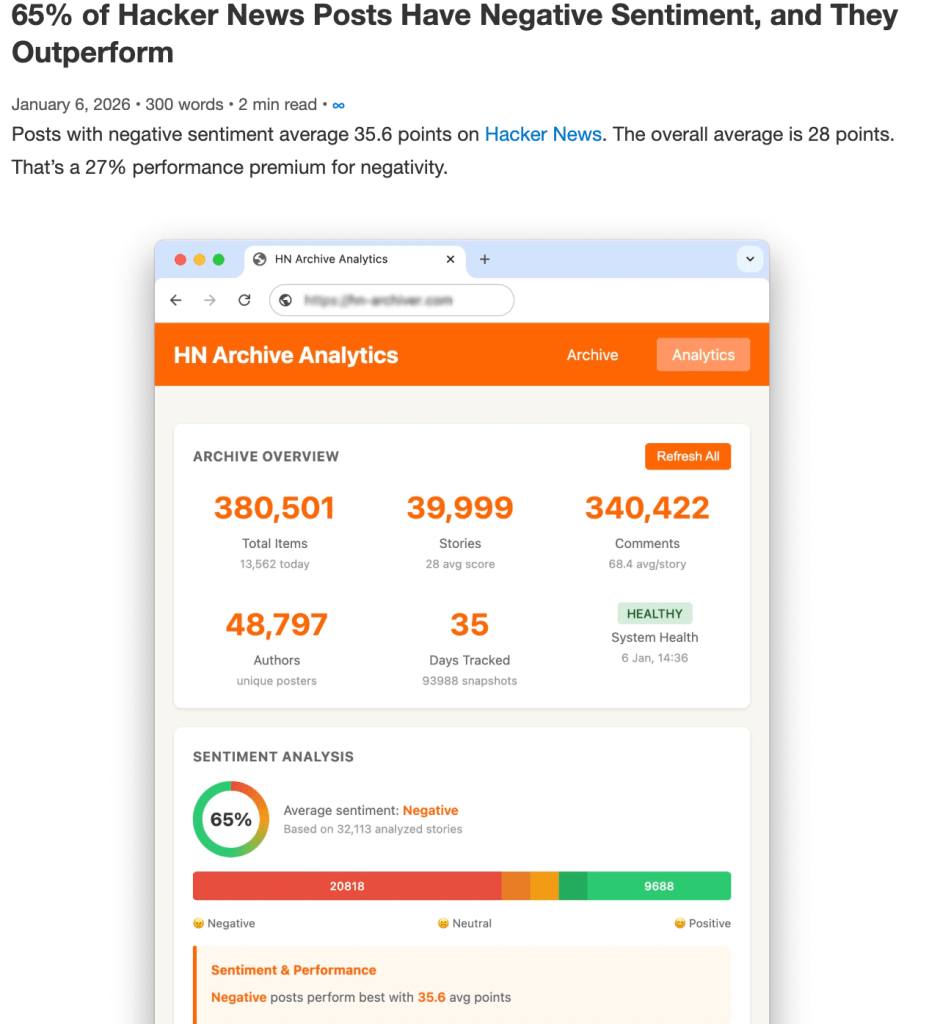
65% of Hacker News Posts Have Negative Sentiment, and They Outperform
Posts with negative sentiment average 35.6 points on Hacker News. The overall average is 28 points. That’s a 27% performance premium for negativity.
Why I’m Leaving Harvard
James Hankins
The year earlier the university had collectively taken a knee during the Summer of Floyd. This turned out not to be empty virtue-signalling, as I expected, but had serious consequences for the way we conducted our affairs. In reviewing graduate student applicants in the fall of 2020 I came across an outstanding prospect who was a perfect fit for our program. In past years this candidate would have risen immediately to the top of the applicant pool. In 2021, however, I was told informally by a member of the admissions committee that “that” (meaning admitting a white male) was “not happening this year.” In the same year a certifiably brilliant undergraduate I had tutored, who was literally the best student at Harvard—he won the prize for the graduating senior with the best overall academic record—was rejected from all the graduate programs to which he applied. He too was a white male. I called around to friends at several universities to find out why on earth he had been rejected. Everywhere it was the same story: Graduate admissions committees around the country had been following the same unspoken protocol as ours. The one exception I found to the general exclusion of white males had begun life as a female.
If the Bay Area once had an impish side, it has gone the way of most hardware tinkerers and hippie communes. Which of the tech titans are funny? In public, they tend to speak in one of two registers. The first is the blandly corporate tone we’ve come to expect when we see them dragged before Congressional hearings or fireside chats. The second leans philosophical, as they compose their features into the sort of reverie appropriate for issuing apocalyptic prophecies on AI. Sam Altman once combined both registers at a tech conference when he said: “I think that AI will probably, most likely, sort of lead to the end of the world. But in the meantime, there will be great companies created with serious machine learning.” Actually that was pretty funny.
Earlier this year, I moved from Yale to Stanford. The sun and the dynamism of the west coast have drawn me back. I found a Bay Area that has grown a lot weirder since I lived there a decade ago. In 2015, people were mostly working on consumer apps, cryptocurrencies, and some business software. Though it felt exciting, it looks in retrospect like a more innocent, even a more sedate, time. Today, AI dictates everything in San Francisco while the tech scene plays a much larger political role in the United States. I can’t get over how strange it all feels. In the midst of California’s natural beauty, nerds are trying to build God in a Box; meanwhile, Peter Thiel hovers in the background presenting lectures on the nature of the Antichrist. This eldritch setting feels more appropriate for a Gothic horror novel than for real life.
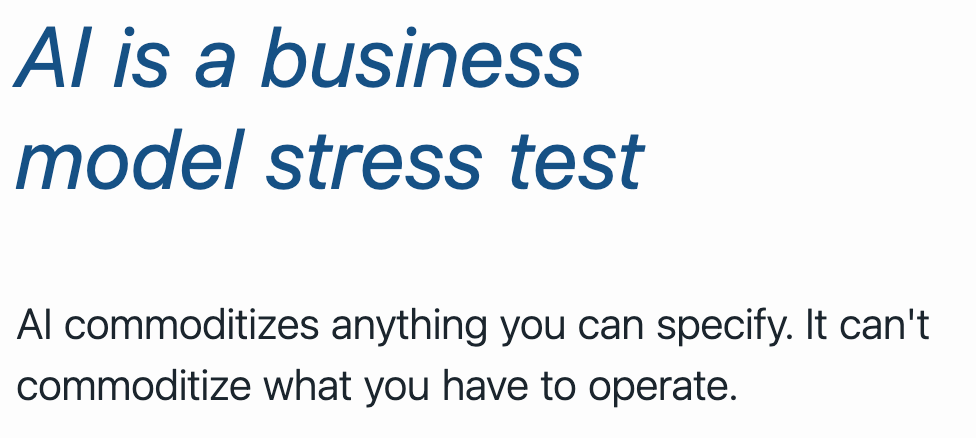
AI didn’t kill Tailwind’s business. It stress tested it. Their business model failed the test, but that is not an indictment of all Open Source business models.
In the last year, more and more developers started asking AI for code instead of reading documentation, and their sales and marketing funnel broke.
What I keep coming back to is this: AI commoditizes anything you can fully specify. Documentation, pre-built card components, a CSS library, Open Source plugins. Tailwind’s commercial offering was built on “specifications”. AI made those things trivial to generate. AI can ship a specification but it can’t run a business.
Orwell outlines six rules he believes writers should abide by:
“(i) Never use a metaphor, simile, or other figure of speech which you are used to seeing in print.
(ii) Never use a long word where a short one will do.
(iii) If it is possible to cut a word out, always cut it out.
(iv) Never use the passive where you can use the active.
(v) Never use a foreign phrase, a scientific word, or a jargon word if you can think of an everyday English equivalent.
(vi) Break any of these rules sooner than say anything outright barbarous.”
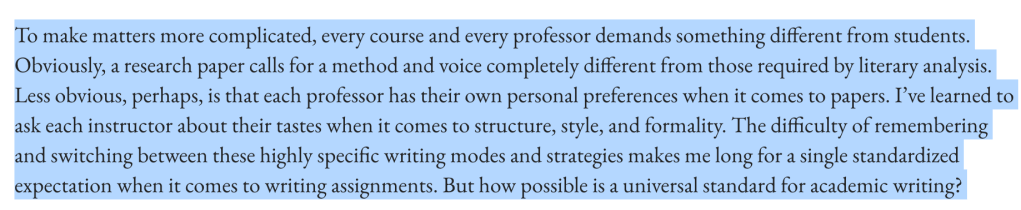
Every course and every professor demands something different from students.
Even if it were possible to create standardized expectations for structure and content, would we want to implement it? High schools’ endeavors in standardization demonstrate that this practice can inhibit rather than empower — the five paragraph essay structure, claim-evidence-reasoning paragraph formula and three-pronged thesis are drilled into students during high school but irrelevant and even condemned in college. As a comparative literature major who has taken courses in philosophy, English, global studies, and, of course, comparative literature, most professors I’ve had have strongly encouraged students to retire the infamous three-pronged thesis and the even more contentious five-paragraph essay format. When I first heard this during the fall of my freshman year, I panicked, wondering how to approach essays if not in the way I had been trained to my entire life.
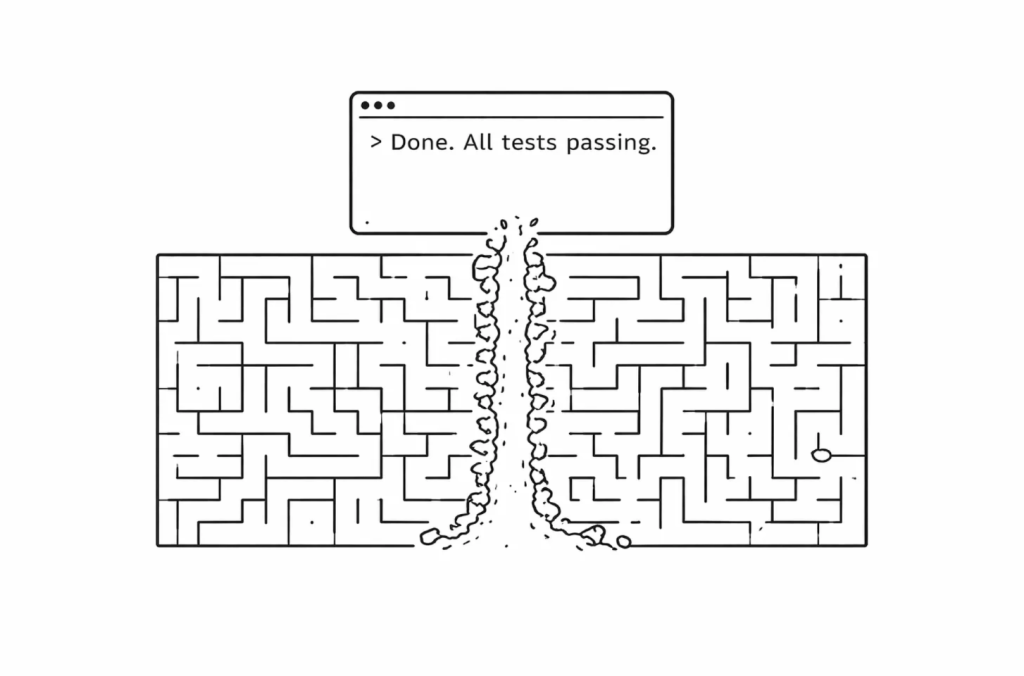
After two years of vibecoding, I’m back to writing by hand
But you find that spec-driven development doesn’t work either. In real life, design docs and specs are living documents that evolve in a volatile manner through discovery and implementation. Imagine if in a real company you wrote a design doc in 1 hour for a complex architecture, handed it off to a mid-level engineer (and told him not to discuss the doc with anyone), and took off on vacation.
Not only does an agent not have the ability to evolve a specification over a multi-week period as it builds out its lower components, it also makes decisions upfront that it later doesn’t deviate from. And most agents simply surrender once they feel the problem and solution has gotten away from them (though this rarely happens anymore, since agents will just force themselves through the walls of the maze.)
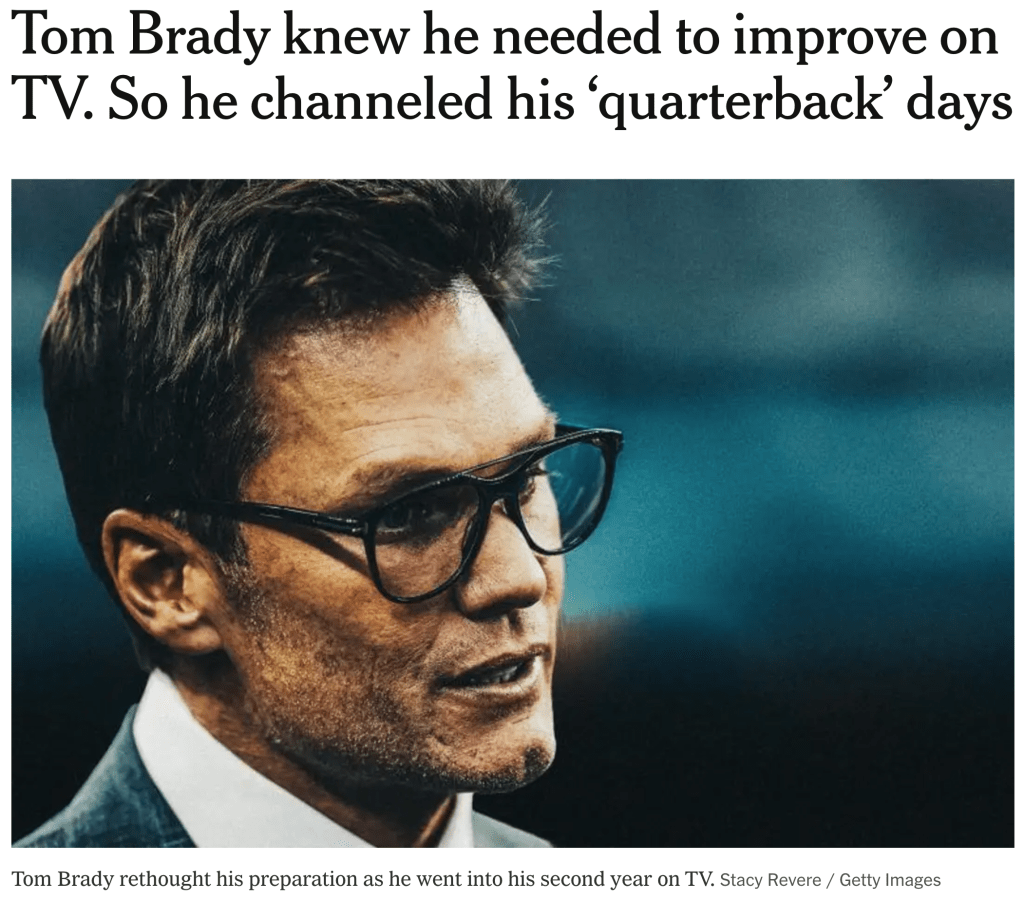
During postgame review sessions of his performances, he would say:
“Why’d I say that?”
“I didn’t like that.”
“That made no sense.”
He wasn’t alone.
Considered the greatest NFL player of all time, Brady was learning a new job — with around 25 million viewers judging each syllable every Sunday afternoon — but he felt like he had training wheels on, trying to find his balance and some success as the season progressed, but never a full rhythm.
“The training wheels come off, and then you have to ride slowly,” Brady told The Athletic.
He wasn’t bad as a rookie, but he wasn’t great either. He showed some flashes, but not consistency. He would have pages and pages of notes that dulled his natural reactions. It was “TMI” — too much information.
“I used to say, ‘All the stuff I prepared, I could read from start to finish in a three-hour broadcast, and I wouldn’t get through all the information,’” Brady said.
This season, he audibled, relying less on overloading himself with outside voices and reams of notes and began scouting the teams as if he were going into sessions with his old Patriots offensive coordinator, Josh McDaniels.
“I started to transition this year into, ‘Let me do more of how I did it as a quarterback,’ because that’s really where my comfort is,” Brady said. “As opposed to, ‘Let me try to prepare as a broadcaster.’”
As his second year closes, Brady has moved to the top of the analysts’ game, where he is now rightly mentioned among the best in the business as he and Fox conclude their season with the NFC Championship Game on Sunday in Seattle.

 proxyii.com